Does every decision involve endless debates with the ‘committee’ inside your head?
Do you accept less than what you should because you’re afraid to speak up?
Do you have difficulty making emotional commitments to others?
Do you think if I don’t commit I can’t be disappointed or disappoint others?
Do you make up excuses that stop you from taking advantage of opportunities for self-improvement?
Does fear of disapproval keep you from doing what you’d really like to do?
A “yes” answer to these
questions indicates a reluctance to take risks, which may mean you tend to play
it safe and reject change.
Consider this: to
fulfill your potential, to discover your real self and live an authentic life,
you must take control, don’t let your fear of change keep you trapped in a
cage. The cage is the absence of change
and while it may appear to be security, it’s not personally rewarding if you
feel trapped. The only genuine security
lies in stepping out of your comfort zone and taking a risk on change.
Learn how I overcame physical pain and changed my life to follow my passion for creating beautiful kimono robes!
What could be riskier than diving out of an airplane or climbing a glacier-covered peak or accelerating a race car into a curve at the Indy 500? While these examples are pulse raising and risk filled, what about life decisions that we face almost daily? For me it was quitting a secure, well-paying job to start a business, 3 Graces Design Studio. For another person, it could be deciding to leave a marriage after 18 years or reporting that the company they work for is endangering the environment or people’s lives.
At first glance, psychological risks that summon us to put our personal values and beliefs on the line may ultimately feel more dangerous than those of physical challenges. Yet these fundamental challenges that we face time and again are the essential sources of growth as individuals. Each time we take a risk that contributes to our personal growth or enhances our self-esteem or enriches our lives, we make the choice to stretch ourselves, knowing there are no guarantees and chancing possible failure.
Growth-producing risks
generally fall into three categories.
Self-Improvement Risks
These are the risks you
take when you want to get ahead, learn something new or make a distant dream a
reality. You take on the venture with hopes of enriching your life. Maybe you
want to change careers, or take ukulele lessons, or learn a language. On one
side of the risk is the person you are and, on the other, the person you want
to become.
Commitment Risks
Commitment risks have
emotional stakes whether you pledge yourself to a person or a relationship or to
a cause, a career, or a value. Joseph Ilardo, author of Risk-Taking for Personal Growth, advises that if you avoid making
emotional commitments, you all but guarantee that personal emotional growth
will be stunted.
Self-Disclosure Risks
Communication risks fall
into the category of self-disclosure. Anytime you tell someone how you really
feel you’re taking the chance of self-disclosure. When you open up to others
and reveal who you really are, how you feel and what you want and need, you
make yourself vulnerable. It is impossible to be assertive without doing so.
All risks carry with them the possibility of failure. Often you have to surrender being in your ‘comfort zone’ before any real benefits are realized. Routines may have to change; the familiar may have to be released. What are the benefits then, why take a risk? Challenging yourself is the key to personal growth and development. It also allows you to let go of expectations or roles that don’t fit who you are or who you want to be. Tomorrow we will post a quiz for you to ask yourself some questions about your level of risk taking.
The Creative Graces from 3 Graces Design Studio recently visited the “Kimono Refashioned” exhibit at the Asian Museum in San Francisco. The exhibit inspired us to design a ‘streetwear’ kimono for a new product line. This tunic length kimono is short enough to wear over jeans or slacks.
Cass designs new patterns
A New Streetwear Kimono
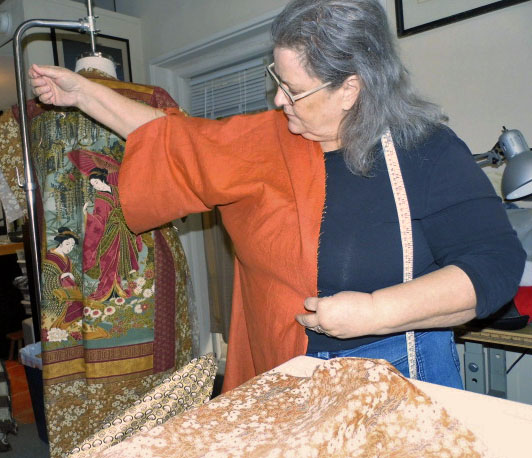
Cassandra Carpenter is the pattern designer for 3 Graces Design Studio. When designing a new pattern, Cass uses her extensive costume library to look for elements she wants to incorporate into the design. This phase requires extensive research and sketching out of ideas. It may take several sketches to determine the best combination of design elements before deciding to make a ‘mock-up’ of the final sketch. Once this phase of the design is complete and the mock up is made changes to length, or sleeve cut will be made for a prototype pattern. In our next segment we will show photos of the prototypes and the design sketches. Be sure to subscribe to our blog to get the latest updates!
I come from a family of creative souls. My sisters and I started 3 Graces Design Studio based on the creative calling we share. We inherited our creative natures from out mother but, the evidence is in other family members as well; a heritage of quilters and painters, artists and film makers, actors, tinkers, thinkers and writers.
The old saying: “Jack-of-all-trades, master of none!” reveals
the bias against those who choose a varied work life rather than committing to
a unidirectional path. There was a time, however, when society admired such a
person. In fact, some of our greatest contributors have been talented in a
variety of areas.
Leonardo da Vinci, painter of
masterpieces such as the Mona Lisa, also designed and built bicycles, canals,
musical instruments and flying machines. Benjamin Franklin not only helped
draft the Declaration of Independence, he was also an inventor, statesman,
printer, scientist, author, and student of French culture and language. More
recently, Maya Angelou, best known as an author and poet, was also a successful
songwriter, journalist, actress, singer, dancer, civil rights worker and
professor. And she could speak eight languages!
Margaret Lobenstine, author of The Renaissance Soul–Life Design for People
with Too Many Passions to Pick Just One, identifies five signs to help
determine whether you are a “Renaissance Soul”:
• The ability to become excited
by many things at once, often accompanied by difficulty choosing
• A love of new challenges; once
challenges are mastered, you are easily bored
• A fear of being trapped in the
same career or activity for life
• A pattern of quick, sometimes
unsatisfying flings with many hobbies
• A successful career that has
left you bored or restless
There is Nothing Wrong with You
People who recognize themselves
in that description often feel that something is wrong with them, that they’re
not normal. They may be accused of an unwillingness to grow up. They may be
called irresponsible, a dilettante, or told they have Attention Deficit
Disorder.
If you fit the above criteria,
take heart. Support is available to help you embrace your strengths and stop
trying to fit into the mold of someone you are not. In fact, your traits make
you an ideal candidate for work that requires flexibility, adaptability to
change, and a broad skill base. Renaissance Souls are often ideal entrepreneurs
since they typically wear many hats in their own business. Public relations,
marketing, consulting and project management are other good choices. Because of
their multifaceted abilities, they may also adapt better in today’s shifting
financial climate and global economy. What’s more, their passionate nature and
curiosity are truly an asset in any arena!
How to Handle Your Passions
In her book Refuse to Choose: A Revolutionary Program for Doing Everything That You
Love, career counselor Barbara Sher provides dozens of tools for dealing
with a multiplicity of passions and also divides what she calls “Scanners” into
nine categories. The “Double Agent” is torn between two interests, while the
“Sybil” is drawn to so many things that she’s often unable to choose anything.
The “Serial Specialist” and “Serial Master” often stick with one career or
project for many years until they’ve gained all they desire from it, and then
move on to master different occupations. Understanding your type can help you
recognize strengths, get support, and choose work that suits you.
Along with clarifying your core
values, Margaret Lobenstine’s “Renaissance
Focal Point Strategy” recommends choosing a “sampler” of four interests and
then rotating them. For example, you might work on a new business venture,
volunteer to teach reading in your local school, take acting lessons and study
Italian. If you want to, in six months you rotate some of those out and choose
others. That way you’re moving out of indecision and into action, honoring your
renaissance soul, and accomplishing goals. A journal and 3-ring binders can
help you track your numerous ideas and keep your projects organized.
Often all it takes is a shift of
attitude to embrace your renaissance nature. Learn to honor its ways and you
may find that your many talents lead you to a fulfilling, passion-filled life.
The sound may be faint
as the stirring of butterfly wings or as loud as a brass band on Fourth of
July. Or you may not hear a sound at all, but feel an urging, an inner pull, a
sense of excitement and longing that resonates from within. This is the call to
create, and it is universal, bidding each of us to bring something new into
being.
“Creativity is the Self
searching for itself,” said George Gamez, Ph.D., author of How to Catch Lightning in a Bottle. We create in order to express our
unique visions and perceptions. We create to communicate and to form a bond
with our fellow human beings. Creative expression helps us feel connected to
the world and builds bridges of understanding. It nourishes us and helps us
grow, provides insights and deeper understandings. Creativity is fun, exciting
and playful. It relieves stress and releases tension. It provides a way of
communication when normal channels may be blocked or are insufficient—when we
must speak in colors and textures and shimmering visions and music.
Creativity is love expressing itself; it heals and renews. Our creations are mirrors in which others may see themselves and the signature of our lives that says, “This is how I saw it.”
Everyone is Creative
No matter what you may
have been told, every one of us is creative. It is as much a part of us as our
voice and breath and fingerprints. Creativity isn’t just about making “art.”
Cooking, gardening, handiwork and crafts, keeping a journal are all creative
acts. Arranging flowers or rearranging furniture, painting a picture or
painting a room, singing on stage or singing in the shower—these are responses
to the call.
Creativity is a way of
living. It is being spontaneous and playful, exercising the imagination,
finding solutions, and embracing possibilities and doing it all with passion.
Yet for all the joy and
fulfillment it brings, some resist the call to be creative. In our culture the
ideas that “Time is money” and “Art is frivolous” hold certain sway, and old
messages such as, “Stay inside the lines” or “You can do better than that” have
remarkable staying power. It takes courage to look beneath the surface of what
we’ve been told in order to find our heart’s desire.
Creativity requires
risk-taking. It asks us to surrender, to lose control and to trust. “Committing
to our creativity is an act of faith,” wrote Jan Phillips, in Marry Your Muse. “A promise to believe
in ourselves.”
Honoring the creative
Self means finding time, making space, being patient and taking the chance of
looking foolish. You cannot care too much what others think or say. You must be
willing to start over and stay with it; creativity takes stamina. There are no
magical secrets or absolute rules. Creativity can’t be taught. You just do it.
“Creativity belongs to the artist in each of us,” said Corita Kent.
Like the body’s natural
urge for motion and the human need for connection and community, the spirit
longs to express itself. So when you hear the call to create, answer, “Yes.” It
is your self searching for your Self, a movement toward being whole.